

Digital mucous cysts
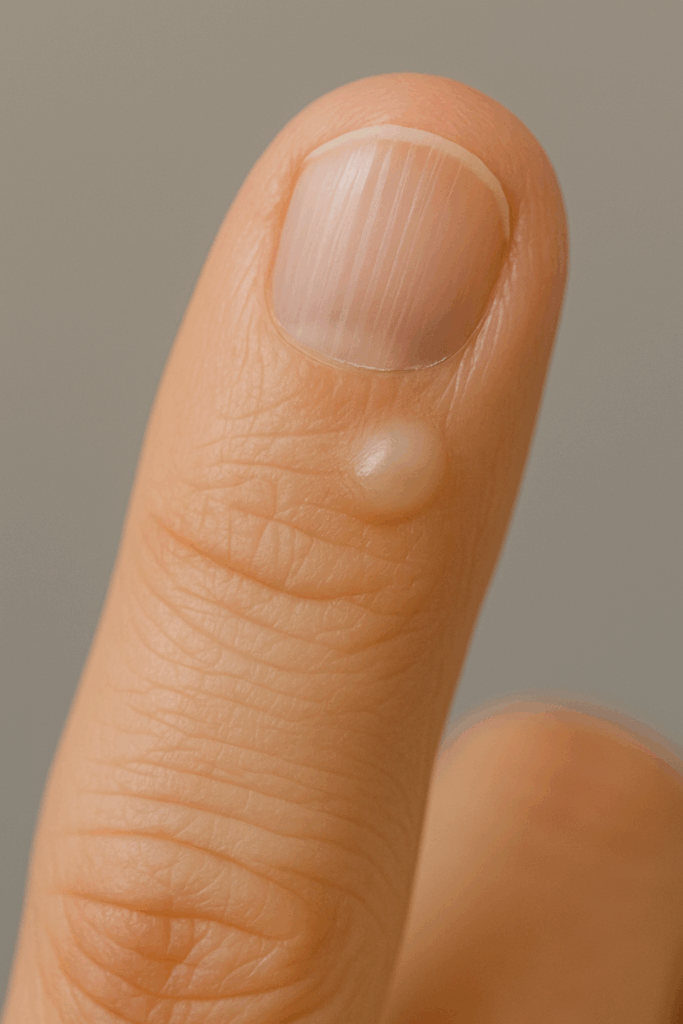
Digital mucous cysts are benign lesions filled with a gelatinous fluid, most often located at the end of the fingers and connected with the distal interphalangeal joint.
1. What is a Digital Mucous Cyst?
A digital mucous cyst is a benign swelling that appears on the back (dorsal surface) of the fingers, generally close to the distal interphalangeal joint. It is filled with a gelatinous fluid that comes from the joint and is often linked to underlying osteoarthritis. When the cyst becomes painful or troublesome, or becomes infected, surgery may be necessary.
2. Causes and symptoms
– A small translucent lump on the back of a finger, often near the nail.
– Pain or discomfort on movement.
– Deformity of the nail if the cyst presses on the nail matrix.
– Possible spontaneous rupture of the cyst with discharge of viscous fluid.
Causes include underlying osteoarthritis of the interphalangeal joints and repeated microtrauma.
3. Surgical Treatment
When the cyst becomes painful, recurs or causes deformity of the nail, I offer an operation to remove the cyst and its connection to the joint completely.
I perform this operation under local anaesthesia. The procedure consists of:
– Carefully incising the skin to expose the cyst.
– Removing the cyst down to its base, making sure to excise the connection to the joint in order to limit recurrence.
– Carrying out a joint debridement if associated osteoarthritis is present.
The procedure takes about 20 to 30 minutes and is performed as day surgery. Complete healing takes a few weeks, with appropriate post-operative follow-up.
4. Post-Operative Advice
– Keep the hand elevated for the first few days to limit swelling.
– Follow the wound care instructions to prevent infection.
– Take the prescribed medication to manage pain.
– Avoid sudden movements or strenuous use of the operated hand during the first few weeks.
– Contact the surgeon in the event of redness, severe pain or fever.
5. Rehabilitation and Exercises
– See a specialist physiotherapist to learn suitable exercises.
– Carry out gentle mobilisation exercises as soon as the surgeon allows.
– Do stretching and progressive strengthening exercises for the fingers and wrist.
– Do the exercises regularly to prevent stiffness and promote a full recovery.
– Follow the ergonomic advice in order to return gradually to everyday activities.